
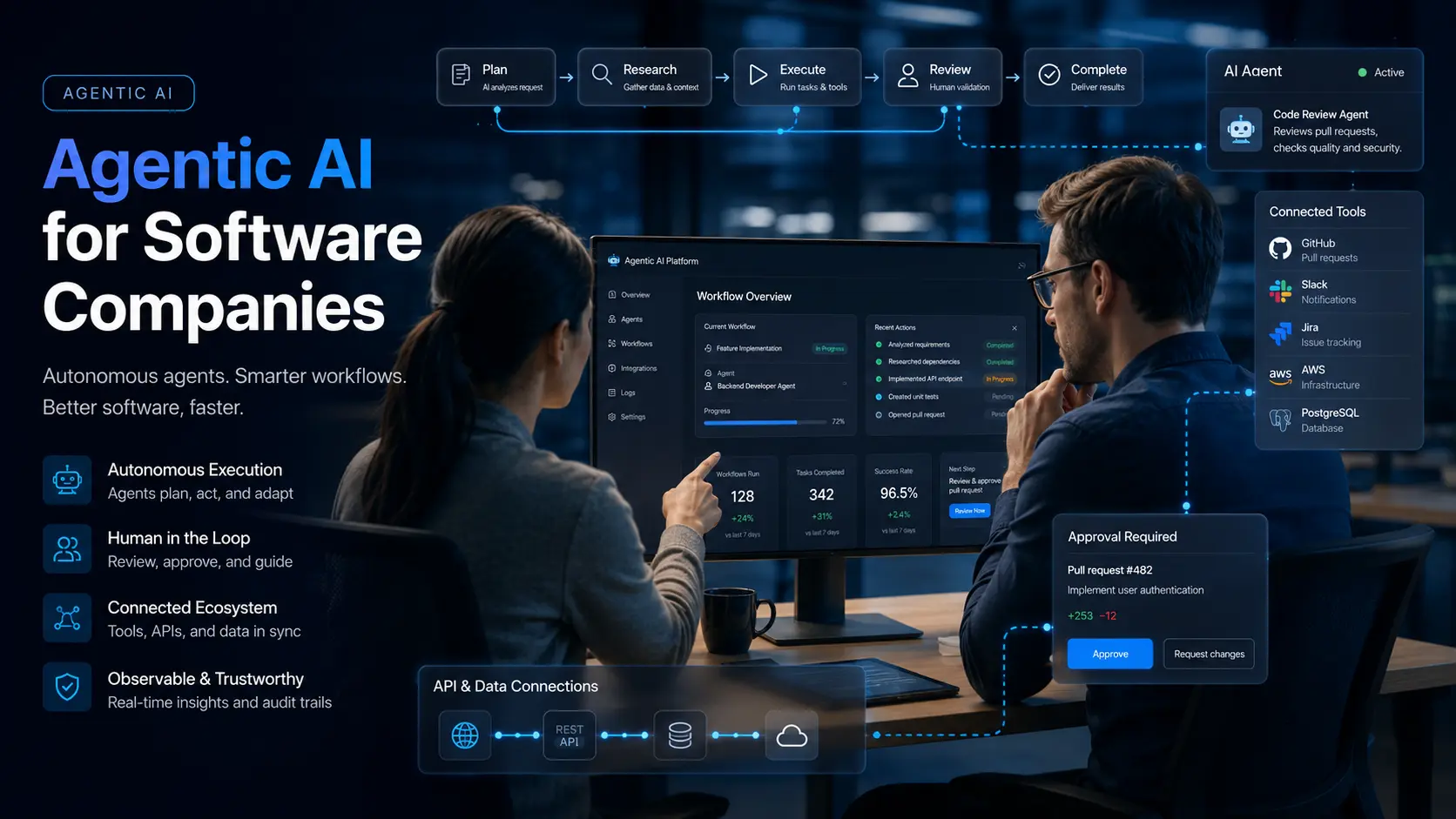
Agentic AI for Software Companies: How Autonomous Workflows Will Change SaaS in 2026
Summary
Agentic AI for software companies is one of the biggest technology shifts of 2026. Traditional software waits for users to click buttons, read dashboards, export reports, and manually complete tasks. Agentic AI changes that model by allowing software to plan, act, observe, correct, and complete business workflows with limited human supervision.
For SaaS companies, custom software providers, startups, and enterprise software teams, agentic AI is not just another chatbot feature. It is a new product layer that can turn software from a passive tool into an active digital teammate.
In this guide, Tekizz IT Services Inc. explains what agentic AI means, how autonomous AI agents work, why agentic workflows are becoming popular in 2026, and how software companies can safely build AI-powered products with real business value.
Introduction: Software Is Moving from Tools to Teammates
For years, software companies built products around dashboards, forms, menus, filters, reports, and notifications. Users opened the software, reviewed information, clicked buttons, made decisions, and then repeated the same process again the next day.
That model is changing fast.
In 2026, businesses are no longer asking only, “Can your software show me the data?” They are asking, “Can your software do the work for me?”
This is the reason agentic AI, autonomous AI agents, and agentic workflows are becoming high-search, high-intent topics across the software industry.
Generative AI helped users create text, images, summaries, and code. Agentic AI goes further. It can understand a goal, break it into steps, use tools, call APIs, check results, and continue until the task is complete.
For software companies, this shift is massive. The next generation of SaaS products will not only display information. They will execute workflows, support decisions, automate operations, and work alongside humans.
What Is Agentic AI?
Agentic AI is an artificial intelligence system that can pursue a goal, make decisions, use tools, and complete multi-step tasks with limited human supervision.
Unlike a basic chatbot, an AI agent does not only answer a question. It can take action.
For example, a normal chatbot may answer, “Here are five leads you should follow up with.” An agentic AI system can review CRM data, rank the best leads, research each company, draft personalized emails, schedule follow-ups, and notify the sales manager for approval.
This is the difference between AI as an assistant and AI as a workflow operator.
Simple Definition
Agentic AI is software that can plan and execute tasks toward a business goal using AI models, tools, memory, data, APIs, and human approval when needed.
Agentic AI vs Traditional AI
Traditional AI usually responds to a single input. Agentic AI works through a loop. It plans, acts, observes the result, corrects mistakes, and continues until the goal is completed.
| Type | How It Works | Business Value |
|---|---|---|
| Chatbot | Answers questions | Support and guidance |
| Generative AI | Creates content | Faster creation |
| Agentic AI | Completes workflows | Automation and execution |
Why Agentic AI Matters for Software Companies in 2026
Software companies are under pressure to deliver more value with less friction. Customers do not want more dashboards if those dashboards still require manual work. They want outcomes.
This is why AI agents for SaaS are becoming important. Agentic AI can help software products become more proactive, personalized, and automated.
For software companies, agentic AI can help with:
- Reducing customer workload
- Improving product stickiness
- Increasing automation inside SaaS platforms
- Reducing churn by delivering faster outcomes
- Creating premium AI-powered product tiers
- Improving onboarding and customer success
- Connecting business tools through APIs
- Building smarter workflows across departments
At Tekizz IT Services Inc., we see agentic AI as a practical software strategy, not just a trend. Businesses can use agentic workflows to automate sales, support, operations, HR, finance, project management, data analysis, and customer communication.
If your business wants to add AI capabilities into a product or internal system, our data and AI services can help plan, design, and implement secure AI-powered workflows.
How Agentic Workflows Work
An agentic workflow is a process where an AI agent repeatedly reasons, takes action, checks results, and improves the next step.
The common loop looks like this:
- Goal: The user gives a target outcome.
- Plan: The agent breaks the goal into smaller steps.
- Act: The agent uses tools, APIs, files, or systems.
- Observe: The agent checks the result.
- Correct: The agent adjusts if something is wrong.
- Complete: The agent gives the final output or asks for approval.
Example: Sales Agent Workflow
A sales manager asks the software, “Find the top 10 leads most likely to convert this week.”
An agentic CRM system can:
- Analyze lead activity
- Check past email engagement
- Review company size and industry
- Score the lead based on intent
- Draft personalized outreach
- Create follow-up tasks
- Ask the sales manager to approve messages
This is not just a report. It is an autonomous workflow.
Old SaaS vs Agentic SaaS
Traditional SaaS products are built around screens. Agentic SaaS products are built around outcomes.
| Old SaaS | Agentic SaaS |
|---|---|
| User clicks menus | Agent starts workflow |
| Dashboard shows data | Agent explains action |
| User exports reports | Agent sends insights |
| Manual follow-up | Automated next step |
| Static automation | Adaptive workflow |
This does not mean dashboards will disappear completely. It means dashboards will become less important than intelligent workflows.
In the future, users may not open five screens to complete a task. They may simply say, “Prepare this week’s sales summary, find risks, draft next actions, and send it for approval.”
The software will do the work.
Core Components of an Agentic AI System
Building agentic AI requires more than connecting a chatbot to an application. A reliable agentic system needs architecture, security, data access, governance, and human oversight.
1. AI Model
The AI model provides reasoning, language understanding, planning, and decision support. It helps the agent understand user intent and decide what to do next.
2. Tools and APIs
Agents need tools to take action. These tools may include CRM APIs, email systems, databases, payment systems, project management platforms, cloud services, or internal business applications.
3. Memory and Context
Agentic AI needs relevant context to work well. This can include customer history, company rules, user preferences, prior decisions, documents, and workflow state.
4. Orchestration Layer
The orchestration layer controls how agents work together. In multi-agent systems, one agent may research, another may analyze, another may write, and another may verify.
5. Human-in-the-Loop Controls
Not every action should be fully automated. High-risk tasks such as sending contracts, issuing refunds, changing financial data, or deleting records should require human approval.
6. Audit Logs
Every agent action should be logged. Businesses need to know what the agent did, why it did it, what data it used, and who approved the action.
7. Security and Access Control
Agentic AI must follow strict permissions. An AI agent should never have unlimited access to sensitive systems. It should only access the tools and data required for its role.
For secure implementation, Tekizz supports AI systems with cybersecurity services, access control planning, cloud security, and secure software architecture.
Best Agentic AI Use Cases for Software Companies
1. AI-Powered CRM Workflows
CRM platforms can use AI agents to research leads, summarize communication, suggest next steps, draft proposals, and schedule follow-ups.
This helps sales teams move faster without manually checking every account.
2. Customer Support Automation
Support agents can read tickets, check product documentation, identify the issue, suggest a fix, create a response, and escalate complex cases to a human team.
This can reduce repetitive support work and improve response time.
3. Software Development Agents
Agentic coding tools can help developers write tests, debug issues, review repositories, generate documentation, and suggest code changes.
For software companies, this creates a major opportunity to improve engineering productivity while keeping human review in place.
4. SaaS Onboarding Agents
An onboarding agent can guide new users through setup, import data, recommend configurations, and explain product features based on the customer’s business model.
This can reduce onboarding friction and improve product adoption.
5. Finance and Billing Workflows
AI agents can help review invoices, identify payment delays, detect missing information, prepare billing summaries, and send reminders after approval.
6. HR and Recruitment Automation
Agentic workflows can screen resumes, summarize candidate profiles, schedule interviews, prepare interview questions, and organize hiring pipelines.
7. IT Operations and Monitoring
AI agents can monitor logs, detect incidents, summarize alerts, recommend remediation steps, and create tickets for technical teams.
This is especially useful when combined with cloud and DevOps services for monitoring, automation, deployment, and infrastructure reliability.
8. Business Reporting Agents
Instead of asking users to create reports manually, agentic AI can collect data from multiple systems, summarize trends, explain risks, and prepare executive summaries.
Why Agentic AI Can Reduce SaaS Churn
Software churn often happens when customers feel the product takes too much effort to use. They may have the data, but they still need to understand it, act on it, and coordinate with their team.
Agentic AI can reduce this friction.
Instead of forcing users to manage every step, software can help complete the work. This makes the product more valuable and harder to replace.
Agentic AI can improve SaaS retention by:
- Reducing manual clicks
- Delivering faster outcomes
- Personalizing workflows
- Improving onboarding
- Creating automated recommendations
- Helping users complete work inside the product
- Increasing daily product usefulness
For software companies, this means agentic AI is not only a feature. It can become a product strategy.
Agentic AI Implementation Roadmap
Software companies should not start agentic AI by trying to automate everything. The best approach is to start with one high-value workflow and build safely.
Step 1: Identify Repetitive High-Value Workflows
Look for workflows that are repeated often, require multiple steps, and create measurable business value.
Good examples include lead follow-up, ticket triage, invoice review, report generation, onboarding, data entry, and internal approval workflows.
Step 2: Define Clear Agent Boundaries
Every AI agent needs a defined role. It should know what it can do, what it cannot do, when it must ask for approval, and which systems it can access.
Step 3: Connect Reliable Data Sources
Agentic AI performs better when it has clean and relevant data. Connect only trusted data sources such as CRM, ERP, project management tools, support platforms, databases, and internal documentation.
Step 4: Add Human Approval Gates
For high-impact actions, include approval steps. For example, an agent may draft a proposal, but a human should approve it before sending.
Step 5: Build the Orchestration Layer
The orchestration layer manages the workflow. It decides which tool or agent should run, what happens next, and how errors are handled.
Step 6: Create Audit Logs and Monitoring
Track every action. A business should be able to review what the agent did, what data it accessed, and what decision path it followed.
Step 7: Test with Real Business Scenarios
Test agentic workflows with real examples before releasing them to customers. Include edge cases, failed inputs, incomplete data, permission errors, and incorrect outputs.
Step 8: Start Small and Scale Gradually
Launch one workflow first. Measure results. Improve the agent. Then expand to more use cases.
If your company needs help designing and building AI-powered software, our custom software development services can help turn agentic AI ideas into secure, scalable applications.
Agentic AI Tech Stack for 2026
The right tech stack depends on your product, industry, budget, and security needs. However, most agentic AI systems include these layers:
- LLM layer: Reasoning, planning, summarization, and decision support.
- Tool layer: APIs, databases, SaaS tools, email, files, and business systems.
- Memory layer: Workflow history, customer context, documents, and preferences.
- Vector database: Search and retrieval from business knowledge.
- Orchestration: Multi-step workflow coordination.
- Guardrails: Rules, limits, validation, and approvals.
- Monitoring: Logs, metrics, alerts, and performance checks.
- Security: Access control, encryption, role permissions, and audit trails.
Popular architecture patterns include single-agent workflows, multi-agent systems, retrieval-augmented generation, human-in-the-loop approval, and event-driven automation.
The main goal is not to use every AI tool available. The goal is to build a reliable workflow that solves a real business problem.
The Big Debate: Will AI Agents Replace Developers?
This question gets attention because it is emotional, controversial, and important.
The better question is not, “Will AI agents replace developers?” The better question is, “How will developers work with AI agents?”
Agentic coding tools can write code, generate tests, debug errors, explain repositories, and automate repetitive tasks. But software development still needs architecture judgment, product thinking, security review, user experience decisions, business logic, compliance awareness, and human responsibility.
In 2026, developers who know how to guide AI agents may become more productive than developers who only write every line manually.
The role is shifting from only coding to:
- Designing systems
- Reviewing AI-generated code
- Creating better prompts and context
- Managing agent workflows
- Testing outputs
- Securing AI-generated changes
- Making product decisions
For software companies, this means AI agents should be treated as engineering accelerators, not uncontrolled replacements.
Risks of Agentic AI Software
Agentic AI is powerful, but it also creates new risks. Software companies must design with safety from the beginning.
1. Wrong Actions at Scale
If an AI agent misunderstands a task, it may repeat the wrong action across many records, customers, or systems.
2. Data Privacy Issues
Agents may need access to sensitive data. Without proper controls, this can create privacy and compliance problems.
3. Over-Automation
Some workflows should not be fully autonomous. Human approval is still important for legal, financial, security, and customer-impacting decisions.
4. Poor Explainability
If users cannot understand why an agent made a decision, trust will be low. Explainable steps and audit logs are essential.
5. Security Misuse
AI agents with too much access can become a security risk. Treat agents like digital users with limited permissions.
6. Vendor Hype
Many tools may claim to be agentic AI but only provide basic automation or chatbot features. Businesses should evaluate real capabilities carefully.
Agentic AI Governance Checklist
Before launching agentic AI, software companies should create a governance checklist.
- Define the agent’s role and allowed actions.
- Use least-privilege access permissions.
- Add human approval for high-risk actions.
- Log every action and decision path.
- Test with real and edge-case scenarios.
- Protect sensitive data with encryption.
- Monitor for unexpected behavior.
- Create rollback and recovery options.
- Review outputs before customer-facing release.
- Update prompts, rules, and workflows regularly.
Safe agentic AI is not only about intelligence. It is about control, transparency, and trust.
High-Intent Keywords Covered in This Blog
This blog is optimized around high-search and high-intent keyword phrases that software companies, SaaS founders, CTOs, and business owners are actively exploring in 2026.
- agentic AI for software companies
- agentic AI implementation
- autonomous AI agents
- agentic workflows
- AI agents for SaaS
- autonomous software workflows
- enterprise AI agents
- LLM agents for enterprise
- multi-agent orchestration
- human-in-the-loop AI
- AI workflow automation
- agentic SaaS
- AI agents in software development
- agentic AI strategy
How Tekizz IT Services Inc. Can Help
Tekizz IT Services Inc. helps businesses build modern software solutions, AI-powered platforms, cloud systems, secure web applications, and automation workflows.
We help software companies and growing businesses explore agentic AI in a practical, secure, and business-focused way.
Our agentic AI and software development support can include:
- Agentic AI strategy planning
- AI workflow automation design
- Custom AI agent development
- SaaS product AI feature planning
- LLM and API integration
- CRM and ERP automation workflows
- Data and AI architecture
- Cloud deployment and DevOps automation
- Human-in-the-loop workflow design
- AI security and access control planning
- Custom dashboards and reporting systems
- Ongoing support and optimization
You can explore our data and AI services, custom software development services, cloud and DevOps services, and cybersecurity services to build a complete AI-ready software foundation.
Frequently Asked Questions About Agentic AI
What is agentic AI in simple words?
Agentic AI is AI that can take action toward a goal. Instead of only answering questions, it can plan steps, use tools, check results, and complete workflows with limited human supervision.
How is agentic AI different from a chatbot?
A chatbot usually responds to user messages. Agentic AI can execute tasks. It can connect with business systems, use APIs, update records, send drafts for approval, and continue a workflow across multiple steps.
Why is agentic AI important for software companies?
Agentic AI helps software companies build products that deliver outcomes, not just dashboards. It can reduce manual work, improve customer experience, increase product value, and create new AI-powered revenue opportunities.
What are examples of agentic AI in SaaS?
Examples include CRM agents, customer support agents, billing agents, onboarding agents, IT monitoring agents, reporting agents, and software development agents.
Is agentic AI safe for business use?
Agentic AI can be safe when built with strong access control, audit logs, testing, human approval, monitoring, and rollback options. Businesses should avoid giving agents unlimited permissions.
Can small businesses use agentic AI?
Yes. Small businesses can start with simple workflows such as lead follow-up, report generation, customer support, invoice review, appointment scheduling, or internal task automation.
Will agentic AI replace software developers?
Agentic AI will change how developers work, but it does not remove the need for human judgment. Developers will still be needed for architecture, review, security, product logic, testing, and business decisions.
What is human-in-the-loop AI?
Human-in-the-loop AI means humans remain involved in important decisions. The AI agent may prepare the work, but a human approves, rejects, or edits the final action.
Final Thoughts
Agentic AI is changing the future of software. The old model of dashboards, filters, and manual clicks is being replaced by intelligent workflows that can plan, act, and support business outcomes.
For software companies, this is a major opportunity. Products that include safe and useful AI agents can become more valuable, more automated, and more difficult to replace.
But success will not come from hype alone. Agentic AI needs clean data, strong architecture, secure APIs, clear permissions, human approval, monitoring, and real business use cases.
The winning software companies in 2026 will not simply add a chatbot. They will build agentic workflows that help customers save time, reduce manual work, and complete important tasks faster.
Ready to Build Agentic AI into Your Software?
Tekizz IT Services Inc. helps businesses design and build AI-powered software, autonomous workflows, custom SaaS products, cloud systems, and secure automation platforms.
Contact Tekizz IT Services Inc. today to discuss your agentic AI implementation, AI workflow automation, SaaS development, or custom software project.