
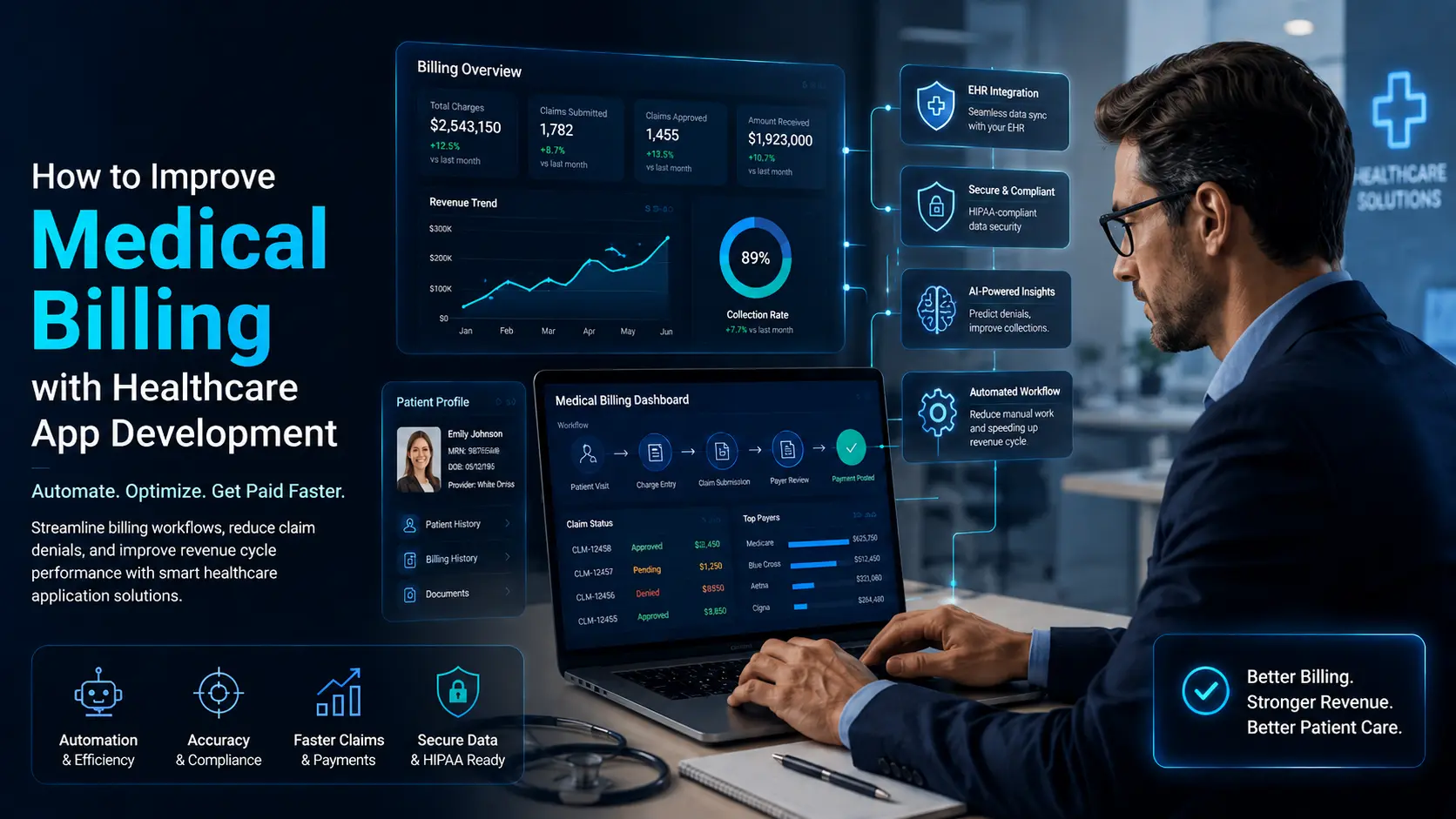
How to Improve Medical Billing with Healthcare App Development
Summary
Medical billing becomes difficult when teams depend on manual data entry, disconnected systems, and limited claim visibility. Healthcare app development helps solve these problems by automating workflows, improving data accuracy, and giving teams real-time control over billing operations.
For healthcare providers, clinics, and medical service companies, the goal is not just to add more software. The goal is to build a smarter, connected system that reduces errors, speeds up reimbursements, and supports long-term growth.
Introduction
Medical billing is one of the most important parts of any healthcare operation, but it is also one of the most stressful. A small mistake in patient information, insurance details, coding, or claim submission can delay payment and create extra work for the billing team.
Many healthcare organizations still manage billing with spreadsheets, manual follow-ups, separate systems, and repeated data entry. At first, this may seem manageable. But as patient volume grows, these small issues quickly turn into claim delays, denial problems, reporting gaps, and revenue leakage.
This is where healthcare app development can make a real difference.
With the right digital system, healthcare businesses can automate billing workflows, connect platforms, track claims in real time, and reduce repetitive manual work. At Tekizz IT Services, we help businesses build secure, scalable, and custom healthcare software solutions that support better operations and smarter decision-making.
Why Medical Billing Processes Break Down
Before improving the billing process, it is important to understand why it breaks in the first place. In most healthcare organizations, the problem is not only one person or one step. It is usually a combination of manual work, disconnected tools, unclear workflows, and poor visibility.
Manual Data Entry Creates Errors
When billing teams enter the same information across multiple systems, errors become almost unavoidable. Patient details, insurance information, procedure codes, and payment records can easily be entered incorrectly or missed completely.
Even a small error can lead to claim rejection, delayed approval, or extra follow-up work. Over time, this slows down the entire revenue cycle.
Disconnected Systems Slow Everything Down
Many healthcare businesses use separate tools for patient records, billing, insurance verification, reporting, and communication. When these systems do not talk to each other, the team becomes responsible for manually moving data from one place to another.
This creates duplicate work, inconsistent records, and delays in claim processing. A connected healthcare application can reduce this friction by bringing important workflows into one structured system.
Limited Visibility Makes Billing Reactive
If your team cannot clearly see where each claim stands, they are forced to react after problems happen. Claims may sit pending, denials may go unnoticed, and payment delays may only be discovered later.
Real-time dashboards and billing status tracking help teams catch issues early. This makes the process more proactive and predictable.
How Healthcare App Development Improves Medical Billing
Healthcare app development is not just about creating a mobile app. It is about building a digital system that supports the way your healthcare business actually works.
A custom healthcare billing app can help with patient intake, insurance verification, claim tracking, billing dashboards, payment updates, team workflows, and reporting.
With the right approach, your billing process becomes faster, cleaner, and easier to manage.
Step-by-Step Ways to Improve Your Medical Billing Process
1. Standardize the Billing Workflow
The first step is creating a clear workflow. Every billing process should have defined stages, from patient intake to final payment posting.
A standard workflow may include:
- Patient registration
- Insurance verification
- Medical coding
- Claim creation
- Claim submission
- Claim status tracking
- Payment posting
- Denial management
- Reporting and review
When every team member follows the same process, it becomes easier to reduce confusion, find bottlenecks, and improve performance.
2. Reduce Manual Data Entry
Manual entry is one of the biggest causes of billing errors. The more times your team enters the same data, the higher the chance of mistakes.
A custom healthcare app can reduce manual work by automatically syncing patient details, insurance data, appointment information, and billing records across systems.
This is where custom software development services can help healthcare businesses create a system that matches their exact billing workflow instead of forcing the team to adjust to generic software.
3. Improve Data Accuracy from the Start
Good billing starts with clean data. If patient or insurance information is wrong at the beginning, the claim is more likely to face delays later.
Healthcare applications can improve data quality by using structured forms, required fields, validation rules, and automated checks. This helps teams catch missing or incorrect information before the claim is submitted.
For example, a healthcare app can alert the team when an insurance ID is incomplete, a required field is missing, or a patient record does not match the billing details.
4. Connect Billing, EHR, and Insurance Systems
Disconnected systems are one of the main reasons billing teams lose time. A custom healthcare solution can connect billing software, EHR platforms, insurance tools, and internal dashboards through secure integrations.
This allows data to move smoothly between systems, reduces duplicate entry, and gives teams one reliable view of the billing process.
For healthcare providers that need reliable infrastructure and deployment support, cloud and DevOps services can help improve system performance, security, scalability, and uptime.
5. Build Real-Time Billing Dashboards
Real-time dashboards help healthcare teams understand what is happening across the billing lifecycle. Instead of waiting for manual updates, managers can instantly see claim status, pending items, denial trends, and payment progress.
A strong billing dashboard can show:
- Total claims submitted
- Claims approved
- Claims pending
- Denied claims
- Average payment time
- Revenue by service type
- Team workload
- Outstanding balances
These insights help leaders make faster decisions and improve the billing process continuously.
6. Automate Claim Tracking and Follow-Ups
Claim follow-up is time-consuming when done manually. A healthcare billing app can automate reminders, status updates, task assignments, and follow-up workflows.
This helps the billing team stay organized and reduces the chance of claims being forgotten or delayed.
Automation can also help notify the right team member when a claim needs review, when documentation is missing, or when a payer response requires action.
7. Monitor Key Billing Metrics
You cannot improve what you do not measure. Healthcare businesses should track the most important billing metrics regularly.
Useful medical billing metrics include:
- Claim denial rate
- First-pass claim acceptance rate
- Days in accounts receivable
- Average reimbursement time
- Payment posting accuracy
- Pending claim volume
- Rework percentage
With custom dashboards and reporting tools, these metrics become easier to track and act on.
The Role of AI in Medical Billing Automation
AI is becoming more useful in healthcare operations because it can help teams identify patterns, reduce repetitive work, and improve decision-making.
In medical billing, AI can support:
- Claim error detection
- Missing information alerts
- Automated document reading
- Denial pattern analysis
- Predictive billing insights
- Smart workflow recommendations
- Automated support responses
AI does not replace the billing team. It supports them by making the process faster, more accurate, and easier to manage.
Businesses that want to use automation and intelligence in their healthcare systems can explore data and AI development services to build smarter workflows and reporting tools.
Why Off-the-Shelf Billing Software Is Not Always Enough
Ready-made billing software can be useful for basic needs. But every healthcare business has different workflows, payer rules, reporting needs, approval processes, and internal team structures.
Off-the-shelf tools may become limiting when your business needs:
- Custom billing workflows
- Advanced dashboard reporting
- Role-based access
- Integration with existing systems
- Custom claim tracking logic
- Mobile access for teams
- Automated notifications
- Special approval flows
Custom healthcare software gives you more flexibility and control. Instead of changing your process to fit the software, you build software that supports your actual process.
Common Mistakes to Avoid When Improving Medical Billing
Adding Software Without Fixing the Workflow
Technology alone does not fix a broken process. If the billing workflow is unclear, adding new software can make confusion worse.
Start by reviewing the current process, identifying gaps, and then building the right digital system around it.
Ignoring Data Quality
Billing depends on accurate information. If patient, insurance, or service data is incomplete, your system will still produce poor results.
Strong validation and clean data entry rules should be part of every healthcare billing application.
Using Too Many Disconnected Tools
Using multiple tools without integration creates more work for your team. A better approach is to connect your systems and centralize important billing data.
Not Tracking Performance Metrics
If you are not measuring claim denials, payment delays, and process bottlenecks, it becomes difficult to know what needs improvement.
A custom dashboard can make these metrics visible and easy to understand.
How Tekizz IT Services Can Help
Tekizz IT Services helps businesses build secure, scalable, and custom software solutions for real operational problems. For healthcare businesses, this can include billing automation tools, patient workflow systems, healthcare dashboards, mobile applications, and cloud-based platforms.
Our approach focuses on understanding your workflow first. Then we design and build a solution that supports your business goals, improves visibility, and reduces manual work.
Tekizz IT Services can help with:
- Healthcare app development
- Medical billing workflow automation
- Custom dashboard development
- EHR and billing system integrations
- Cloud-based healthcare platforms
- AI-powered reporting tools
- Secure web application development
- Healthcare mobile app development
- Role-based admin panels
- Long-term support and scaling
If your healthcare business needs mobile access, secure patient workflows, or app-based billing support, our mobile app development services can help you create a smooth experience for both teams and users.
Benefits of a Custom Healthcare Billing Application
A well-built healthcare billing application can improve both daily operations and long-term business performance.
Key benefits include:
- Reduced manual billing work
- Fewer data entry errors
- Faster claim tracking
- Better visibility for managers
- Improved team productivity
- Cleaner reporting
- Secure access control
- Better patient and payer communication
- Scalable workflow management
Most importantly, it gives your team a system that is easier to use and easier to improve over time.
Final Thoughts
Improving your medical billing process starts with better systems. When your workflow is clear, your data is accurate, and your tools are connected, billing becomes less stressful and more predictable.
Healthcare app development helps bring structure, automation, and visibility into a process that is often slowed down by manual work and disconnected platforms.
If your billing team is spending too much time fixing the same issues, tracking claims manually, or working across separate systems, it may be time to build a smarter digital solution.
Ready to Improve Your Medical Billing Process?
Tekizz IT Services helps healthcare businesses build secure, scalable, and custom digital solutions that improve workflows, reduce manual work, and support smarter operations.
Contact Tekizz IT Services today to discuss your healthcare app development, billing automation, custom dashboard, or software integration project.