
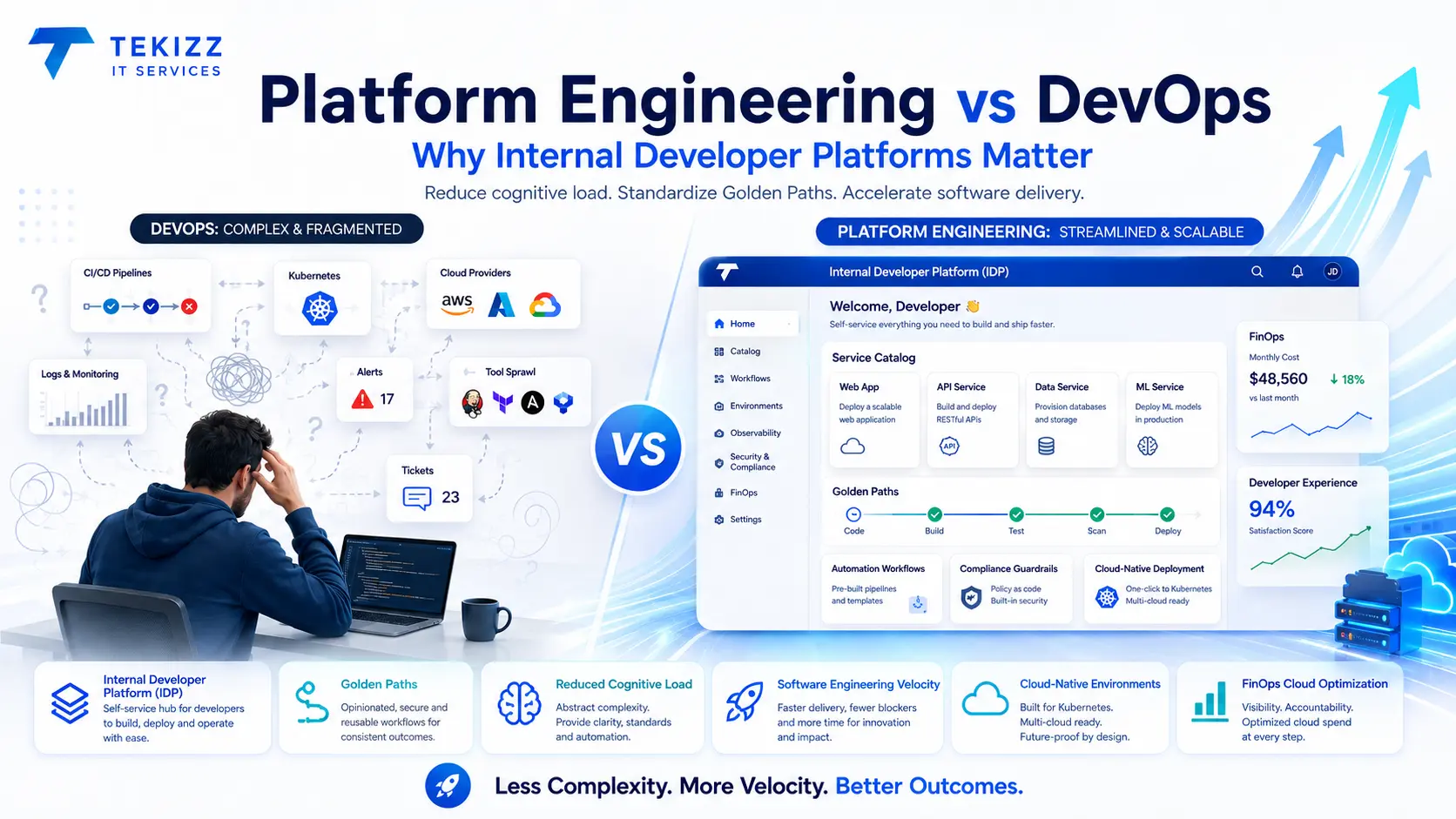
Platform Engineering vs DevOps: Why Enterprises Need Internal Developer Platforms
For the last decade, DevOps promised faster software delivery by bringing development and operations closer together. The idea was right. The execution, in many enterprises, became heavy. Developers were asked to write features, manage pipelines, understand Kubernetes, configure cloud services, monitor production, handle security controls, review cost reports, and still ship faster.
My opinion is simple: traditional DevOps did not fail, but it became overloaded. The next stage is Platform Engineering. For CTOs and VPs of Engineering, the real question is no longer only “Platform Engineering vs DevOps.” The better question is: how do we give engineering teams self-service power without forcing every developer to become an infrastructure expert?
At TEKIZZ IT SERVICES, we see platform engineering as a practical way to reduce friction, improve software engineering velocity, and create a better developer experience across cloud-native environments.
What Is the Real Difference Between Platform Engineering and DevOps?
DevOps focuses on collaboration between development and operations. Platform engineering focuses on building internal products that make that collaboration easier, safer, and more repeatable.
In many organizations, DevOps became a shared responsibility model where every product team had to understand too much infrastructure detail. That created a serious problem: increased cognitive load on developers. Instead of focusing on customer value, developers spend too much time searching documentation, fixing pipeline issues, managing environments, and waiting for approvals.
Platform engineering solves this by creating an Internal Developer Platform (IDP). An IDP gives developers a self-service way to create applications, deploy services, request environments, view documentation, monitor systems, and follow approved delivery patterns.
Platform Engineering vs DevOps: Quick Comparison
| Area | Traditional DevOps | Platform Engineering |
|---|---|---|
| Main Focus | Collaboration between dev and ops teams | Self-service platforms for developers |
| Developer Experience | Often depends on scripts, tickets, and tribal knowledge | Uses portals, templates, automation, and Golden Paths |
| Infrastructure Complexity | Often pushed to product teams | Abstracted through reusable platform capabilities |
| Governance | Manual reviews and scattered controls | Built-in compliance, security, and policy guardrails |
| Speed | Can slow down as systems grow | Improves software engineering velocity through automation |
The Problem: Developers Are Carrying Too Much Infrastructure Complexity
Modern engineering teams work inside complex cloud-native environments. They use containers, APIs, CI/CD pipelines, secrets, observability tools, identity systems, databases, queues, security scans, infrastructure as code, and cost dashboards.
These tools are powerful, but without a platform strategy they become fragmented. Every team builds its own scripts. Every project creates its own deployment method. Documentation becomes outdated. Security checks become inconsistent. Cloud cost visibility becomes reactive instead of proactive.
This is where developer burnout starts. Not because developers cannot learn infrastructure, but because they should not need to solve the same platform problems again and again.
The CEO Perspective: Platform Engineering Is a Business Strategy, Not Just a Technical Trend
From a leadership perspective, platform engineering is not only about developer tools. It is about business execution.
When engineering teams move slowly, the business moves slowly. Product releases get delayed. Security reviews take longer. Cloud costs become unclear. New developers take months to become productive. Teams spend more time managing internal complexity than solving customer problems.
A strong platform engineering strategy helps enterprises create consistency without blocking innovation. It gives developers freedom inside a safe, automated system.
If your enterprise is planning digital products, SaaS platforms, AI systems, mobile apps, or business automation, your internal delivery platform becomes a competitive advantage. You can also explore our SaaS product development services and custom software development solutions to understand how platform thinking supports scalable product delivery.
What Is an Internal Developer Platform?
An Internal Developer Platform (IDP) is a centralized system that gives developers self-service access to the tools and workflows they need. It can include:
- Application templates
- CI/CD pipeline automation
- Cloud environment provisioning
- Security and compliance checks
- Service catalog and ownership records
- API documentation
- Monitoring and observability links
- Deployment workflows
- Cost visibility and FinOps dashboards
The goal is not to hide everything from developers. The goal is to remove unnecessary complexity while still giving teams the control they need.
Golden Paths: The Secret to Faster and Safer Delivery
A Golden Path is an approved, reusable, and automated way to complete a common engineering task. For example, instead of asking every team to build its own deployment process, the platform team provides a standard path for launching a new service.
A good Golden Path can help developers:
- Create a new microservice with approved architecture
- Deploy to cloud-native environments safely
- Use standard logging and monitoring
- Follow security and compliance rules automatically
- Connect to APIs and databases through approved patterns
- Reduce repeated manual setup work
Golden Paths should not become cages. They should be paved roads. Developers can move faster because the basic foundation is already handled.
Why Backstage Open Source Matters
Many enterprises are exploring Backstage open source as a foundation for internal developer portals. A developer portal gives engineering teams one place to find services, documentation, ownership, APIs, templates, and platform workflows.
For example, a CTO may want every service to have clear ownership, lifecycle status, documentation, deployment links, and observability dashboards. A platform portal makes this visible in one place instead of spreading it across chat messages, spreadsheets, old documents, and multiple tools.
This is especially useful for enterprises with many teams, microservices, cloud platforms, and compliance requirements.
A Practical Blueprint for Building a Self-Service Developer Platform
Enterprises should not start platform engineering by buying tools first. They should start by identifying friction.
Step 1: Map Developer Pain Points
Talk to developers and engineering managers. Find where time is being lost.
- How long does it take to create a new service?
- How many tickets are needed before deployment?
- Where do developers search for documentation?
- Which cloud setup tasks are repeated manually?
- Where do security reviews slow down delivery?
Step 2: Build a Service Catalog
Create a single source of truth for applications, APIs, owners, repositories, documentation, environments, and dependencies. This improves visibility and reduces confusion.
If your business already manages complex systems, review our backend API development services and CRM and ERP software development capabilities for related architecture planning.
Step 3: Create Golden Paths
Start with the most common workflows:
- Create a new web app
- Create a new backend API
- Deploy a service to staging
- Deploy a service to production
- Add monitoring and alerts
- Request a cloud database
Each Golden Path should include templates, automation, security checks, and documentation.
Step 4: Add Security and Compliance by Default
Security should not be a final manual checkpoint. It should be built into the platform. This includes access control, secrets management, dependency scanning, audit logs, approval workflows, and policy checks.
For companies building AI-enabled products, security and governance become even more important. Learn more about our AI software development services for secure and scalable AI-driven systems.
Step 5: Include FinOps Cloud Optimization
Cloud cost cannot remain only a finance problem. Engineering teams need visibility into cost impact. FinOps cloud optimization should be part of the developer platform.
A strong platform can show teams:
- Estimated cost before provisioning resources
- Monthly cost by service or team
- Unused cloud resources
- Budget alerts
- Right-sizing recommendations
This helps teams build responsibly while still moving fast.
How Platform Engineering Improves Software Engineering Velocity
Velocity does not come from asking developers to work harder. It comes from removing friction.
Platform engineering improves software engineering velocity by:
- Reducing repetitive infrastructure tasks
- Making deployment faster and more consistent
- Improving onboarding for new developers
- Reducing dependency on manual tickets
- Making security and compliance easier to follow
- Improving visibility across services and ownership
- Reducing cognitive load on developers
The result is not only faster delivery. The result is better delivery with less burnout.
When Should an Enterprise Invest in Platform Engineering?
You should consider platform engineering if your organization has:
- Multiple development teams
- Frequent cloud deployments
- Microservices or distributed systems
- Slow developer onboarding
- Repeated DevOps tickets
- Inconsistent CI/CD workflows
- Security and compliance pressure
- Rising cloud costs
- Difficulty tracking service ownership
If these problems sound familiar, your issue may not be developer performance. Your issue may be platform design.
How TEKIZZ IT SERVICES Can Help
At TEKIZZ IT SERVICES, we help businesses design and build modern digital systems with the right balance of speed, security, and scalability. Our work includes web application development, mobile app development, backend systems, SaaS platforms, cloud-ready applications, workflow automation, and enterprise software solutions.
We also help teams think beyond one project. The right architecture should support long-term growth, easier maintenance, stronger security, and faster releases.
You can explore our case studies, including finance dashboard development, CRM and ERP business automation, and logistics tracking software development, to see how structured digital systems improve business operations.
Final Opinion: Platform Engineering Is the Future of Practical DevOps
DevOps created the culture. Platform engineering creates the operating system for that culture.
Enterprises should not keep pushing more infrastructure complexity onto developers and call it ownership. Real ownership means giving teams the right tools, clear paths, safe automation, and self-service systems that help them deliver value faster.
The future belongs to companies that build strong internal platforms, reduce cognitive load, improve developer experience, and connect engineering speed with business outcomes.
If your organization is ready to modernize software delivery, build scalable applications, or improve engineering operations, TEKIZZ IT SERVICES can help you plan the right digital foundation.
Ready to build smarter software systems? View our services, explore our portfolio, or contact TEKIZZ IT SERVICES today.