
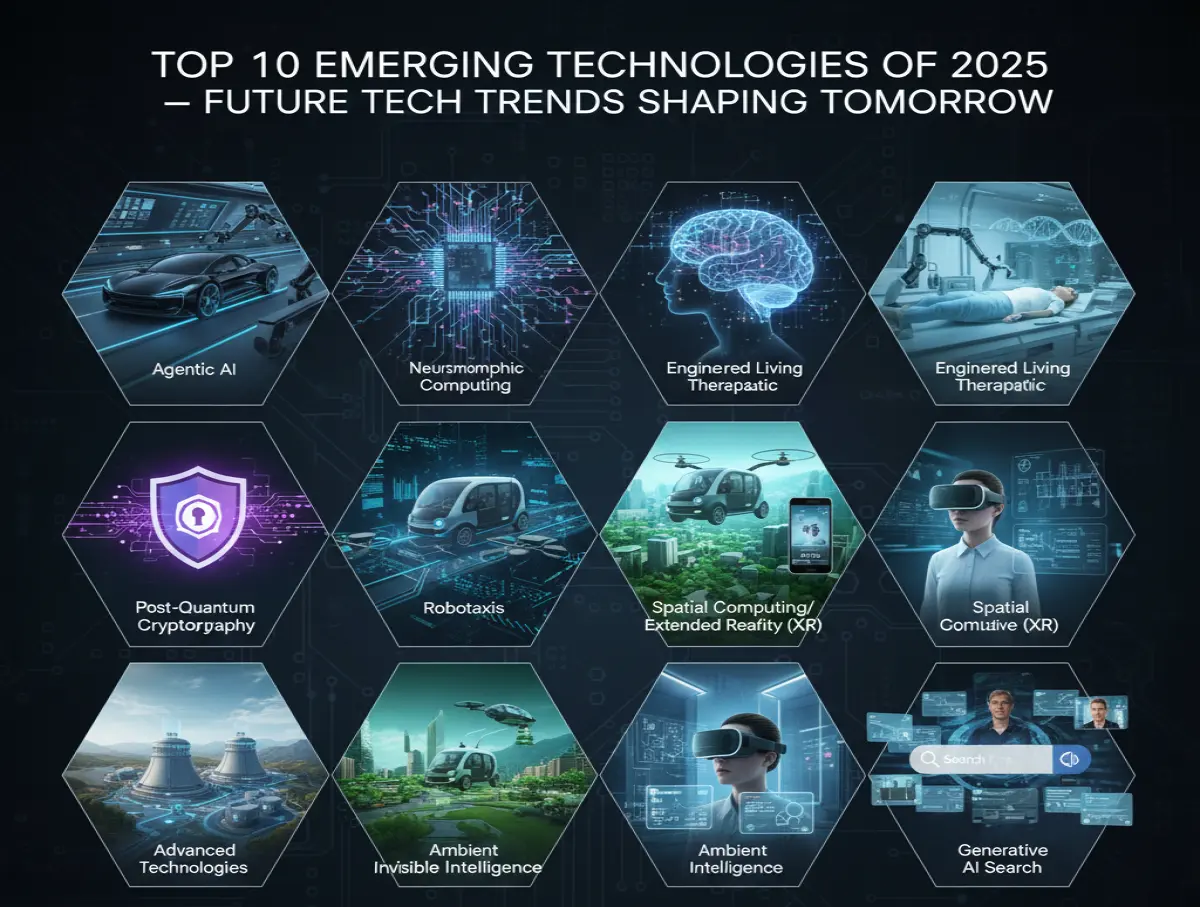
Top 10 Emerging Technologies of 2025 – Future Tech Trends Shaping Tomorrow
Research suggests that AI-driven innovations like agentic AI and generative tools are set to dominate in 2025, though ethical concerns persist. Sustainable tech, such as advanced nuclear and green materials, appears likely to tackle climate issues, while quantum advancements may reshape security. For businesses trying to turn these trends into action, the most immediate opportunities often sit in data and AI services, secure digital platforms, and scalable cloud adoption.
What Makes These Tech Trends Stand Out? These emerging technologies of 2025 combine AI, biotech, and advanced computing to address major global challenges. Drawing from sources like WEF and Gartner, they promise economic growth but also raise important questions around equity, regulation, and operational risk.
How to Stay Ahead in Future Tech Trends 2025 Businesses should monitor these shifts for practical opportunities. For example, investing in AI governance, secure infrastructure, and resilient engineering can help organizations adopt innovation without losing control. That is why many companies now combine experimentation with stronger cloud and DevOps foundations and cybersecurity readiness.
In 2025, the world of technology is evolving rapidly with breakthrough trends that promise to transform industries and daily life. If you’re searching for what the top emerging technologies are in 2025 or which future tech trends matter most, this guide covers the biggest developments shaping the next phase of business and innovation.
From AI advancements to the future of quantum computing, these trends are already influencing product design, operations, analytics, customer experiences, and long-term strategy. For businesses that want to respond practically instead of only tracking headlines, Tekizz supports that journey through technology services, product engineering, and real-world implementation support.
Whether you’re interested in innovative technology trends, enterprise adoption, or future-proofing your company, this guide highlights where the biggest momentum is building.
Why Explore Top Emerging Technologies 2025 Now? 🚀
As 2025 progresses, these trends are accelerating because of post-pandemic resilience demands, exploding data volumes, and the need for faster business adaptability. Technologies like agentic AI and post-quantum cryptography could dramatically change how organizations compete, automate, and protect critical systems.
At the same time, controversies around energy use, regulation, privacy, and job displacement show why organizations need a thoughtful adoption plan. Businesses that pair innovation with strong custom engineering, secure deployment, and governance are far more likely to benefit from these shifts than those that chase trends without structure.
Selection Methodology for Future Tech Trends 2025 📊
These top 10 trends were selected based on business impact, technical maturity, momentum, and the likelihood of real-world adoption. Some trends are already creating measurable change in enterprise environments, while others are still moving from experimental stages toward broader implementation.
This balanced view is important because technology hype can distort business priorities. The goal is not just to ask what is exciting, but what is practical, scalable, and strategically useful.
1. 🤖 Agentic AI: Autonomous Systems Revolutionizing Work
Agentic AI, one of the most important AI advancements in 2025, refers to systems that can autonomously plan, reason, and execute tasks.
- Why It Matters: It boosts productivity across logistics, healthcare, analytics, and operations.
- Key Players: Google, Microsoft, Adept.
- Impacts: It enables more autonomous businesses, while also raising job displacement and governance concerns.
- Challenges: It needs strong guardrails, oversight, and bias controls.
- Examples: Workflow orchestration, RPA in finance, autonomous assistants, and decision-support systems.
For organizations trying to use these systems in real projects, this trend connects directly with AI and analytics services and scalable software delivery.
2. 🔒 Post-Quantum Cryptography: Securing the Quantum Era
Post-quantum cryptography is becoming essential as organizations prepare for a future where quantum computing could break current encryption standards.
- Why It Matters: It protects finance, healthcare, government, and enterprise systems from future quantum-enabled attacks.
- Key Players: IBM, Google Quantum AI.
- Impacts: It helps reduce major cyber risk and supports long-term trust in digital systems.
- Challenges: It can introduce performance trade-offs and migration complexity.
- Examples: Encryption modernization, secure communications, and long-term compliance planning.
This is especially relevant for companies investing in stronger cybersecurity services and secure enterprise architecture.
3. 📱 Small Language Models / Micro LLMs: Efficient AI for All
Compact language models optimized for narrow use cases are becoming a practical alternative to large, expensive AI systems.
- Why It Matters: They make AI deployment more efficient, more affordable, and more accessible across devices and business workflows.
- Key Players: OpenAI, Hugging Face, device-focused AI vendors.
- Impacts: They enable faster real-time applications and lighter infrastructure demands.
- Challenges: They may lack the flexibility and general reasoning of larger models.
- Examples: On-device AI assistants, lightweight enterprise copilots, and embedded search experiences.
For companies building customer products around these use cases, this trend often aligns with mobile app development and web application development.
4. 🚗 Robotaxis and Physical AI: Mobility Redefined
Driverless systems and physical AI are pushing automation beyond software into transportation, robotics, and real-world operational environments.
- Why It Matters: It has the potential to reshape logistics, public mobility, and industrial efficiency.
- Key Players: Waymo, Tesla, robotics startups.
- Impacts: It may reduce emissions and improve operational efficiency while raising regulation and safety questions.
- Challenges: Reliability, real-world safety, legal frameworks, and cost barriers remain major hurdles.
- Examples: Driverless transport, warehouse robotics, and AI-assisted field operations.
5. ⚡ Advanced Nuclear Technologies: Clean Energy Powerhouse
Advanced nuclear systems such as small modular reactors are gaining attention as a way to support future energy demand, including the heavy power needs of AI infrastructure.
- Why It Matters: It could help meet rising energy needs in a lower-carbon way.
- Key Players: NuScale, TerraPower.
- Impacts: It may support decarbonization and large-scale compute demands.
- Challenges: Waste management, regulation, cost, and public trust remain major issues.
- Examples: Industrial SMRs and next-generation clean energy planning.
6. 🧬 Engineered Living Therapeutics: Biotech Breakthroughs
Engineered living therapeutics use modified biological systems as treatment methods for complex and chronic diseases.
- Why It Matters: It opens new possibilities for precision medicine and long-term care.
- Key Players: Editas Medicine and other biotech innovators.
- Impacts: It can change how conditions like cancer and chronic infections are treated.
- Challenges: Ethics, affordability, and accessibility remain significant concerns.
- Examples: Cell-based therapies and gene-edited treatment systems.
7. 🕶️ Spatial Computing / Extended Reality (XR): Immersive Worlds
Spatial computing blends digital and physical experiences through AR, VR, and mixed-reality environments.
- Why It Matters: It improves training, field support, collaboration, and immersive commerce.
- Key Players: Apple, Meta.
- Impacts: It could reshape enterprise training, product demos, and service delivery.
- Challenges: Hardware costs, privacy concerns, and user adoption barriers remain.
- Examples: AR-guided repairs, immersive training, and next-generation digital workspaces.
For product-oriented businesses, these experiences often rely on strong frontend and platform execution through React frontend development and broader custom software development.
8. 🔍 Generative AI Search and Synthetic Media: Information Revolution
Generative search experiences and synthetic media tools are changing how people consume information, create content, and interact with digital platforms.
- Why It Matters: They can improve speed, accessibility, and personalization.
- Key Players: Google, Apple, major AI vendors.
- Impacts: They support faster learning and content generation while also increasing misinformation risks.
- Challenges: Accuracy, source trust, and bias remain major concerns.
- Examples: AI-generated summaries, virtual hosts, and personalized knowledge experiences.
Businesses exploring these use cases often need a combination of AI integration, application strategy, and secure content governance.
9. 🌐 Ambient Invisible Intelligence: Seamless Integration
Ambient intelligence embeds AI into everyday environments so systems respond without demanding constant user interaction.
- Why It Matters: It improves smart homes, retail operations, urban systems, and workplace efficiency.
- Key Players: Amazon and a growing ecosystem of smart-device and platform vendors.
- Impacts: It increases automation and convenience in physical environments.
- Challenges: Privacy, surveillance concerns, and governance issues remain central.
- Examples: Smart stores, real-time asset tracking, and intelligent building systems.
10. 🧠 Neuromorphic Computing: Brain-Inspired Efficiency
Neuromorphic computing uses brain-inspired architectures to improve speed and efficiency in AI workloads.
- Why It Matters: It may help overcome the energy and performance limits of conventional systems.
- Key Players: Intel and next-generation chip research groups.
- Impacts: It could enable faster edge AI and more efficient real-time computing.
- Challenges: Complexity, tooling maturity, and commercial scalability are still developing.
- Examples: Edge inference, robotics, and specialized AI chips.
Comparative View: Top Emerging Technologies of 2025
| Technology | Main Business Value | Common Challenge |
|---|---|---|
| Agentic AI | Autonomous workflows | Governance |
| Post-Quantum Cryptography | Future-ready security | Migration cost |
| Small Language Models | Efficient AI deployment | Narrower scope |
| Robotaxis / Physical AI | Operational automation | Safety and regulation |
| Advanced Nuclear | Scalable clean energy | Trust and regulation |
| Engineered Living Therapeutics | Precision medicine | Ethics and access |
| Spatial Computing / XR | Immersive business experiences | Adoption barriers |
| Generative AI Search | Faster information access | Accuracy and bias |
| Ambient Intelligence | Seamless automation | Privacy |
| Neuromorphic Computing | Efficient AI processing | Scalability |
Ongoing Trends and Controversies in Innovative Tech 2025 🔮
Beyond this top 10, broader themes like disinformation security, sustainability, AI governance, and digital trust continue to shape adoption. AI’s environmental cost is being debated alongside clean-energy innovation, while privacy and equity remain central concerns in smart cities and ambient intelligence.
By 2030, these shifts could reshape business models, workforces, and competitive advantage across industries. But long-term success will depend on responsible rollout, strong execution, and real business alignment.
If your business wants to move from technology trend-watching to practical implementation, Tekizz can help through AI and analytics services, cloud modernization, cybersecurity services, and custom software development. You can also contact Tekizz to discuss the right emerging technology roadmap for your business.