
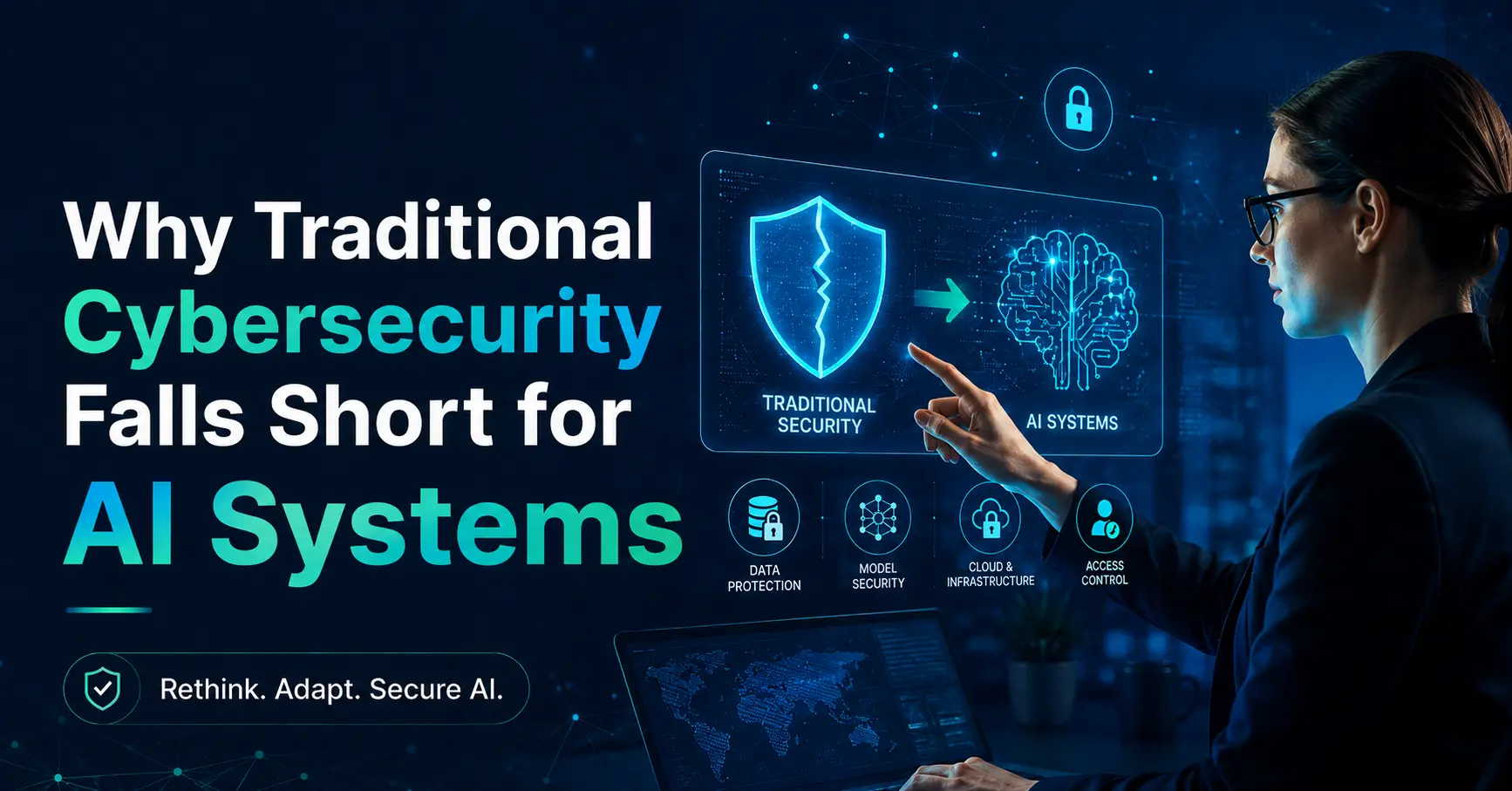
Why Traditional Cybersecurity Falls Short for AI Systems
Artificial intelligence is now becoming a core part of modern business operations. Companies are using AI to automate workflows, improve customer experiences, analyze large volumes of data, detect patterns, and make faster decisions. But as AI adoption grows, the security risks around these systems also become more complex.
Traditional cybersecurity was mainly designed to protect websites, servers, networks, applications, databases, and user access. That approach still matters, but AI systems introduce a different type of risk. They depend on data quality, model behavior, training pipelines, third-party APIs, cloud environments, and continuous learning. Because of this, protecting AI systems requires more than standard security controls.
At Tekizz, we see AI security as a complete lifecycle responsibility. It is not only about blocking attacks. It is about protecting the data, the model, the infrastructure, the application, and the business decision-making process behind the system.
Why traditional cybersecurity struggles with AI
Traditional cybersecurity usually works well when systems are predictable. For example, a normal web application has known users, fixed permissions, defined APIs, standard databases, and clear infrastructure boundaries. Security teams can apply firewalls, authentication, access control, vulnerability scanning, endpoint protection, monitoring, and backup strategies.
AI systems are different. They are not always static. Their output can change based on new data, user input, model updates, prompts, integrations, and business context. This makes AI security harder because the system is not only processing information; it is also generating responses, predictions, recommendations, or decisions.
A traditional security model may detect unauthorized login attempts, suspicious IP activity, or malware. But it may not easily detect poisoned training data, prompt injection, model manipulation, biased outputs, sensitive data leakage through AI responses, or misuse of an AI-powered workflow.
The assumptions behind traditional cybersecurity
Most traditional cybersecurity frameworks are built around fixed assumptions. These assumptions are useful for normal software systems, but they are not always enough for AI-powered environments.
- Software behavior is mostly predictable.
- Threats usually target infrastructure, networks, or user accounts.
- Access control is enough to protect sensitive systems.
- Logs and alerts can explain most security incidents.
- Applications do not change their behavior unless developers update them.
AI changes these assumptions. A model can produce unexpected output even when the infrastructure is secure. A user can manipulate prompts without breaking into the system. Bad data can influence future decisions without triggering a normal security alert. This is why AI systems need a more intelligent and adaptive security strategy.
How AI changes the cybersecurity risk question
In traditional systems, security teams often ask, “Who accessed the system?” or “Was there an unauthorized action?” These are still important questions, but AI requires additional questions.
- Can we trust the data used by the model?
- Can the model be manipulated through input?
- Is the AI system exposing sensitive information?
- Are the model outputs accurate, safe, and explainable?
- Is the AI workflow being used for the right business purpose?
- Can we trace how a decision or prediction was produced?
For example, a customer support chatbot may be protected behind secure login and HTTPS. But if a user can trick the chatbot into revealing internal policies, customer data, or system instructions, then the application is still exposed. In this case, the issue is not only infrastructure security. The issue is AI behavior security.
Traditional security vs. AI security
| Security Area | Traditional Cybersecurity | AI System Security |
|---|---|---|
| Core Asset | Applications, servers, databases, and networks | Data, models, prompts, APIs, pipelines, and decisions |
| Main Risk | Unauthorized access, malware, phishing, and system compromise | Model manipulation, prompt injection, data poisoning, and unsafe output |
| Security Focus | Protecting infrastructure and user access | Protecting the full AI lifecycle from data to deployment |
| Monitoring | Logs, alerts, access attempts, and network activity | Model behavior, response quality, drift, bias, and abnormal AI usage |
| Governance | Policies, roles, permissions, and compliance checks | Explainability, accountability, data governance, and model risk management |
The AI cybersecurity challenges traditional tools often miss
AI systems create security challenges that are difficult to manage with only standard tools. These risks can appear across development, deployment, and production environments.
1. Data poisoning
AI models depend heavily on data. If the training data, fine-tuning data, or input data is manipulated, the model can learn incorrect patterns or produce harmful results. Traditional cybersecurity tools may not detect this because the data may look normal at the infrastructure level.
2. Prompt injection
Prompt injection happens when a user gives instructions that attempt to override the intended behavior of an AI system. This can cause the model to ignore rules, expose restricted information, or perform actions it should not perform. This is especially important for chatbots, AI assistants, and systems connected to internal tools.
3. Sensitive data leakage
AI systems may accidentally reveal confidential information if proper controls are not applied. This can happen through prompts, generated responses, logs, training data, or third-party integrations. For businesses handling customer, financial, healthcare, or internal operational data, this becomes a serious security concern.
4. Model drift
AI models can become less reliable over time as data patterns change. This is called model drift. A traditional security tool may show that the system is online and functioning, but it may not show that the model is making poor or risky decisions.
5. Lack of explainability
Many AI systems make decisions that are difficult to explain. If a business cannot understand why a model gave a certain output, it becomes harder to audit, secure, and improve the system. This is especially important in regulated industries.
A better approach to AI cybersecurity
Businesses need to move from a purely infrastructure-based security model to a lifecycle-based AI security model. That means security should be included from the beginning of AI planning, not added only after deployment.
A strong AI security approach should include:
- Secure data collection and validation
- Access control for datasets, models, and APIs
- Prompt and input protection
- Model monitoring and drift detection
- Regular testing for AI-specific vulnerabilities
- Secure cloud and DevOps practices
- Audit logs for AI decisions and user interactions
- Human review for high-risk AI outputs
Tekizz helps businesses build this type of security-first foundation through cybersecurity services, data and AI solutions, and cloud and DevOps engineering.
How Tekizz supports secure AI systems
At Tekizz, we understand that AI security is not a single tool or one-time checklist. It requires a practical combination of secure engineering, cloud architecture, data governance, monitoring, and business awareness.
Our team helps organizations design, develop, and secure AI-powered applications with a strong focus on reliability, scalability, and risk reduction. Whether a business is building an internal AI assistant, predictive analytics platform, automation workflow, or customer-facing AI solution, security must be part of the complete system design.
Tekizz can support AI security through:
- Secure AI architecture: Designing AI systems with proper access control, cloud security, and data protection.
- Data pipeline security: Protecting data movement, storage, validation, and transformation processes.
- Application security: Securing APIs, dashboards, admin panels, and user-facing AI applications.
- Cloud security: Implementing secure deployments, monitoring, logging, and infrastructure controls.
- DevSecOps practices: Adding security checks into CI/CD pipelines and development workflows.
- AI monitoring: Tracking model performance, abnormal usage, drift, and risky outputs.
If your organization is planning to build an AI-powered platform, Tekizz can help you create the right foundation from the start. Explore our custom software development services or connect with our team through the contact page.
What business leaders should rethink
AI security is not only a technical responsibility. Business leaders, product teams, compliance teams, and engineering teams all need to work together. The key question is no longer only, “Is our system protected?” The better question is, “Can we trust how our AI system behaves, learns, and responds?”
Leaders should think about:
- Who owns AI security inside the organization?
- What data is being used to train or power the AI system?
- How are AI outputs reviewed and monitored?
- What happens if the AI system gives a harmful or incorrect response?
- How are users, developers, and administrators held accountable?
These questions help businesses move beyond basic protection and toward responsible AI adoption.
Protecting intelligence, not just infrastructure
Traditional cybersecurity is still important, but it is no longer enough on its own. AI systems need security that protects intelligence, not just infrastructure. That means protecting the data, the model, the application, the cloud environment, and the decisions created by the system.
As AI becomes more common in business, companies that take security seriously will be better prepared to innovate safely. They will also build more trust with customers, employees, and partners.
Tekizz helps businesses design secure, scalable, and future-ready digital solutions. Whether you need support with web development, mobile app development, Node.js development, Python development, or AI security planning, our team can help you build with confidence.
Next step
If your business is using AI or planning to build an AI-powered product, now is the right time to review your security approach. A secure AI system starts with the right architecture, clean data practices, strong access control, continuous monitoring, and a trusted development partner.
Contact Tekizz today to discuss how we can help you build secure, reliable, and intelligent digital solutions.