
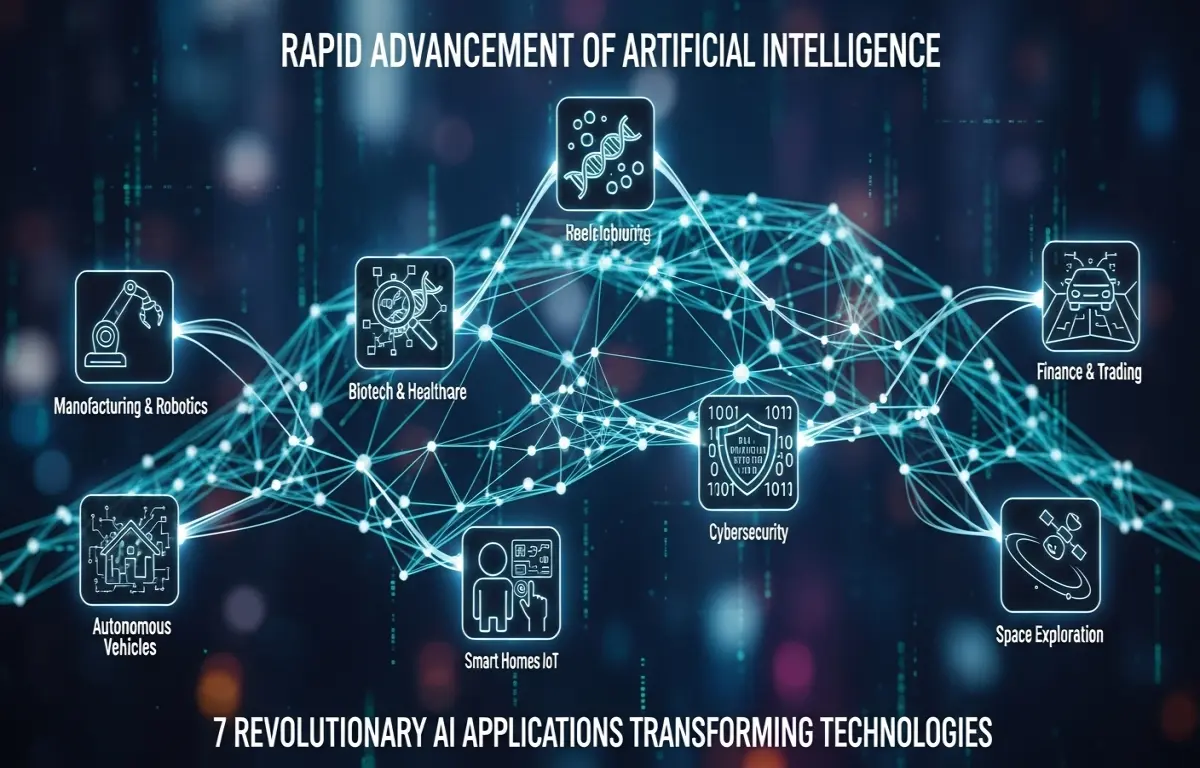
Rapid Advancement of Artificial Intelligence: 7 Revolutionary AI Applications Transforming Technologies in 2025
What's Driving the Rapid Advancement of Artificial Intelligence? 🚀
The explosive growth in AI technologies isn't happening in a vacuum. Key factors are propelling this rapid advancement of Artificial Intelligence forward, influencing top AI trends and research directions:
- Exponential Compute Power 💻: Innovations in chips, distributed infrastructure, and model optimization are unlocking massive processing capabilities, enabling more sophisticated AI models, faster training times, and seamless deployment across cloud and edge environments. Businesses building on this foundation often rely on scalable cloud and DevOps services to support AI workloads reliably.
- Vast Data Ecosystems 📊: The growth of connected platforms, sensors, and enterprise systems gives AI access to enormous training datasets. That is why strong data and AI services are becoming central to modern analytics, automation, and decision-making.
- Algorithmic Breakthroughs 🧠: Advances in deep learning, neural networks, and generative AI are making systems smarter, more efficient, and more capable of handling complex tasks such as content generation, pattern recognition, and intelligent automation.
- Widespread Industry Integration 📈: With more companies increasing AI investment each year, artificial intelligence is becoming a core strategy for product development, customer service, personalization, and business efficiency. This is also driving demand for custom software development that can embed AI directly into real business workflows.
These elements are not only accelerating AI trends in 2025, but also making advanced AI more accessible through cloud platforms, APIs, and production-ready application stacks.
7 Transformative AI Applications Across Various Technologies 🔍
The rapid advancement of Artificial Intelligence is evident across multiple industries, from automation and analytics to cybersecurity and digital experiences. Here are seven key areas where AI technologies are making a significant impact.
1. AI in Healthcare: Precision Diagnostics and Lifesaving Innovations 🏥
In healthcare, AI applications are transforming patient care through predictive analytics, pattern recognition, and personalized treatment approaches. Machine learning models can support early detection of diseases through imaging and diagnostic systems, while generative AI is speeding up research workflows and clinical documentation. The combination of AI, analytics, and real-time decision support reflects the growing value of data-driven AI implementation across critical sectors.
2. AI in Finance: Enhanced Security and Intelligent Trading 📊
Finance is using AI for fraud detection, algorithmic trading, and risk assessment. Real-time anomaly detection can flag suspicious behavior, while machine learning models improve forecasting and credit evaluation. As finance platforms become more digital and interconnected, businesses also need stronger cybersecurity services to protect sensitive systems, transactions, and customer data.
3. AI in Transportation: Autonomous Systems and Optimized Logistics 🚗
The rapid advancement of Artificial Intelligence is steering transportation toward autonomy and efficiency. AI applications include self-driving systems, sensor fusion, route optimization, and logistics forecasting. In supply chains and mobility platforms, these use cases often depend on scalable cloud infrastructure and modern engineering architecture to support real-time performance and resilience.
4. AI in Education: Personalized Learning and Adaptive Platforms 🎓
Education is being reshaped by AI technologies that personalize content and adapt learning paths based on user progress. Machine learning enables dynamic learning environments that improve engagement and tailor materials to individual needs. For professionals who want to build practical AI and analytics skills, Tekizz also offers Data Science training and broader IT courses to help learners move from theory to application.
5. AI in Manufacturing and Engineering: Automation and Predictive Maintenance 🏭
Manufacturing continues to gain from AI-driven automation, robotics, and predictive maintenance. By analyzing equipment data and production signals, AI can reduce downtime, improve planning, and optimize operations. These kinds of solutions often require strong product integration and tailored engineering, which is why companies increasingly invest in custom engineering services and custom software platforms to support intelligent manufacturing workflows.
6. AI in Entertainment and Media: Immersive Content Creation 🎥
Entertainment platforms use AI for recommendation engines, content generation, personalization, and immersive user experiences. Generative AI is now shaping text, images, music, and interactive content, while recommendation systems continue to improve engagement across streaming and digital platforms. Businesses building these experiences often combine AI with modern frontend development and web application development to deliver scalable digital products.
7. AI in Defense and Communications: Secure Networks and Adaptive Systems 🛡️
In defense and communications, AI supports signal routing, threat detection, adaptive response, and secure network operations. Machine learning helps systems detect patterns faster and respond to evolving risks with greater precision. In commercial environments, these same principles are now being applied through managed cybersecurity, intelligent monitoring, and AI-assisted defense strategies.
Navigating Challenges in the Rapid Advancement of Artificial Intelligence ⚠️
While AI technologies offer major benefits, challenges such as workforce impact, ethics, privacy, model reliability, and security risks still need serious attention. The widening gap between organizations with mature AI capabilities and those without them makes responsible rollout even more important. Companies that want to scale safely should combine AI innovation with strong governance, secure architecture, and disciplined deployment practices through services like AI implementation, cloud modernization, and cybersecurity protection.
Conclusion: Harness the Power of AI Technologies Today 🌟
The rapid advancement of Artificial Intelligence and its applications across various technologies are not just trends—they are becoming the foundation of tomorrow's digital economy. From healthcare breakthroughs to financial security, logistics automation, and personalized learning, AI is driving efficiency, creativity, and business transformation.
If you want to move beyond reading about AI and start applying it in real products, platforms, and workflows, Tekizz can help through data and AI services, custom software development, and practical training programs. If you are planning your next AI initiative, contact Tekizz today to explore the right solution for your business.