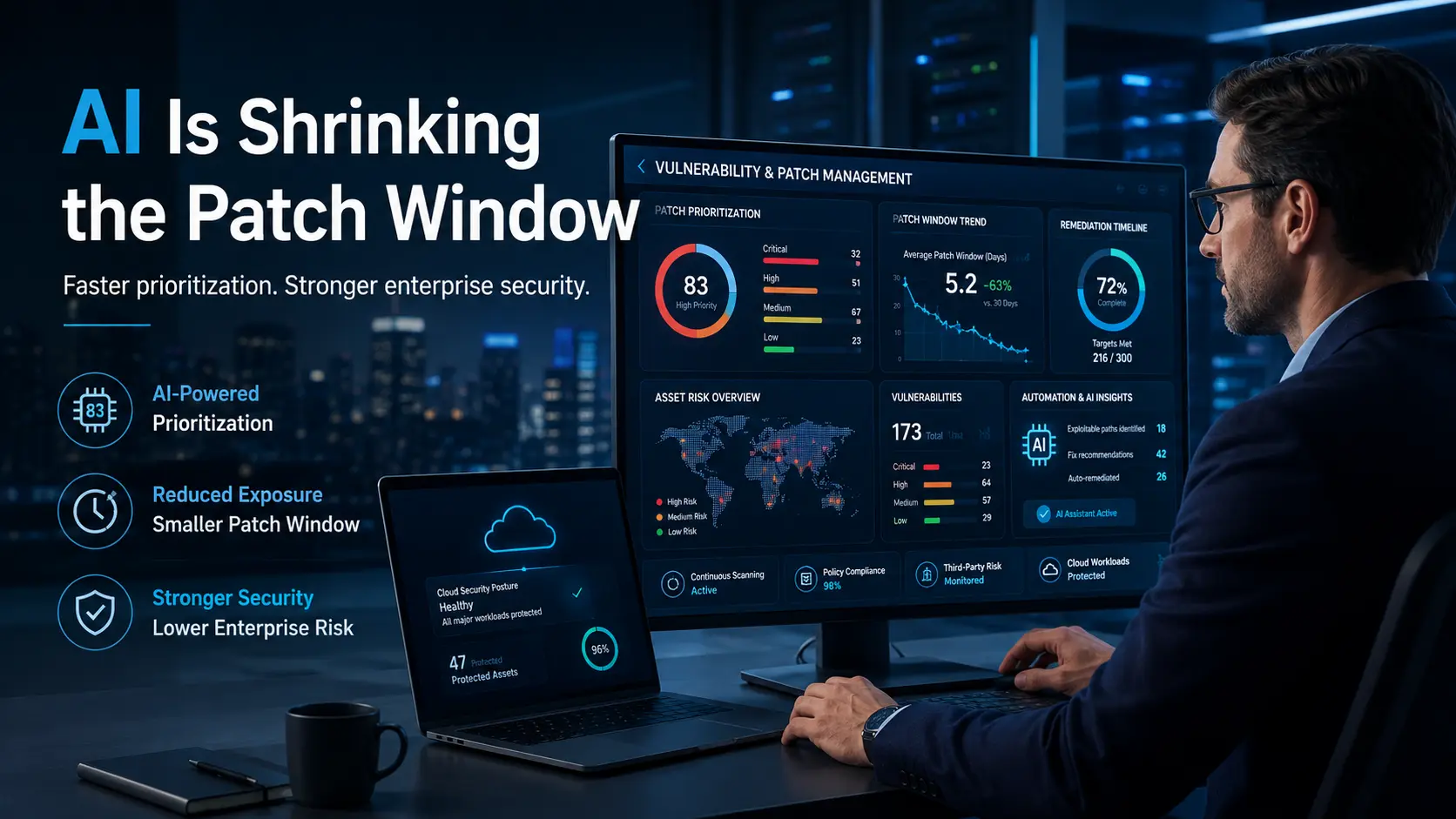
AI Is Shrinking the Patch Window: Why U.S. Enterprises Need Faster Vulnerability Management
Summary
AI is changing how quickly vulnerabilities can be discovered, tested, and exploited. For U.S. businesses, the traditional patching model of waiting for the next maintenance window is becoming too slow for today’s threat landscape.
Modern enterprises need a faster, risk-based vulnerability management process that combines CISA KEV, EPSS, CVSS, asset exposure, cloud security, and DevSecOps automation. At Tekizz IT Services Inc., we help organizations build secure, scalable, and faster-response technology environments designed for modern cyber risk.
Introduction
For years, many enterprise security teams worked under one basic assumption: even when a vulnerability was disclosed, there was usually enough time to review it, prioritize it, schedule a patch, test the fix, and deploy it during the next approved maintenance window.
That assumption is becoming dangerous.
AI-powered security research, automated exploit development, exposed cloud services, and agent-based systems are reducing the time between vulnerability disclosure and real-world exploitation. In simple terms, attackers and researchers can move faster than many enterprise patching processes were designed to handle.
This does not mean every company should panic. It means organizations need a smarter process.
For U.S. enterprises, SaaS companies, healthcare organizations, fintech businesses, logistics platforms, and cloud-first teams, vulnerability management must become more automated, more risk-based, and more connected to real business exposure.
That is where a modern cybersecurity and DevSecOps strategy becomes essential.
Why Traditional Enterprise Patching Is No Longer Enough
Traditional patch management often follows a calendar-based process. A vulnerability is published, the security team reviews it, the infrastructure or application team validates the impact, a change request is created, and deployment happens during an approved maintenance cycle.
That process worked better when exploit timelines were slower.
Today, many critical vulnerabilities are scanned, tested, and exploited much faster. Public disclosures, automated scanning tools, AI-assisted exploit research, and exposed internet-facing systems have changed the speed of risk.
The real problem is not just the vulnerability itself. The real problem is the gap between when a vulnerability becomes known and when the business actually reduces exposure.
For many enterprises, that gap is too large.
What AI-Driven Vulnerability Discovery Changes
AI is now being used to support code review, security testing, vulnerability reproduction, exploit analysis, and software research. This can help defenders find and fix weaknesses faster, but it also raises the bar for how quickly organizations must respond.
Anthropic’s Claude Mythos Preview showed how advanced AI systems can assist in finding and reproducing complex software vulnerabilities in controlled security research environments. The important lesson for enterprises is clear: vulnerability discovery is becoming faster, and the bottleneck is shifting from finding issues to verifying, prioritizing, and fixing them.
This creates a new challenge for security teams. If AI can accelerate discovery, then businesses need to accelerate remediation.
That does not mean every vulnerability needs emergency treatment. It means enterprises need a better way to decide which vulnerabilities deserve immediate action and which can follow normal remediation timelines.
The Biggest Weakness: CVSS-Only Prioritization
Many organizations still prioritize vulnerabilities mainly by CVSS score. CVSS is useful because it explains technical severity, but it does not always tell you whether a vulnerability is being actively exploited or whether it is likely to be targeted soon.
A vulnerability with a high CVSS score may be serious in theory, but it may not be reachable in your environment. Another vulnerability with a slightly lower score may already be exploited in the wild and exposed on an internet-facing system.
That is why CVSS alone is not enough for modern patch prioritization.
A better process should combine:
- CISA KEV to identify vulnerabilities known to be exploited in the wild
- EPSS to estimate the probability of exploitation
- CVSS to understand technical severity
- Asset exposure to determine whether the vulnerable system is internet-facing or business-critical
- Business context to understand operational impact and customer risk
This approach gives security teams a more realistic view of what needs urgent attention.
A Smarter Model: KEV + EPSS + CVSS
A modern vulnerability management program should move from basic severity scoring to risk-based triage. One practical model is a three-layer prioritization filter.
Layer 1: Known Exploited Vulnerabilities
If a vulnerability appears in the CISA Known Exploited Vulnerabilities catalog, it should be treated as urgent. These are vulnerabilities that have already been observed in real-world exploitation.
For internet-facing systems, authentication systems, cloud services, AI tools, and production infrastructure, KEV-listed vulnerabilities should move into immediate remediation or compensating control workflows.
Layer 2: Exploit Probability
EPSS helps estimate the probability that a CVE will be exploited in the wild within a near-term window. This gives teams more context than severity alone.
If a vulnerability has a high EPSS score and affects a system that is exposed or business-critical, it should be escalated faster than a vulnerability with low exploitation probability.
Layer 3: Technical Severity
CVSS still matters. High-severity and critical vulnerabilities should remain part of the remediation process, but CVSS should be combined with KEV, EPSS, and business exposure.
This layered approach helps security teams avoid wasting emergency effort on every high-score vulnerability while still responding quickly to the issues attackers are most likely to use.
Example Priority Table for Enterprise Teams
| Priority Layer | Signal | Recommended Action | Target Response |
|---|---|---|---|
| Critical Exposure | CISA KEV listed or active exploitation confirmed | Immediate patching or compensating controls | Hours |
| High Risk | High EPSS score and exposed asset | Escalate to priority remediation pipeline | 24 hours |
| Severity-Based | High CVSS score but no active exploitation signal | Patch through standard remediation process | Policy-based |
| Monitored | Low exploit probability and low exposure | Track, validate, and remediate normally | Standard cycle |
Why Event-Driven Patching Matters
Calendar-based patching is predictable, but attackers do not wait for your maintenance window. For critical systems, enterprises need event-driven patching.
Event-driven patching means your security process reacts automatically when high-risk conditions are detected. For example, if a critical vulnerability is published, appears in KEV, has a high EPSS score, and affects an internet-facing asset, the system should immediately alert the right team and start the remediation workflow.
This does not mean skipping testing or change control. It means creating a faster path for high-risk vulnerabilities.
For U.S. enterprises with cloud infrastructure, SaaS platforms, healthcare systems, or financial applications, this type of response can reduce exposure and improve operational resilience.
If your company needs help building secure deployment workflows, our cloud and DevOps services can support automated release pipelines, monitoring, rollback planning, and infrastructure hardening.
Do Not Ignore AI Agent Security
AI agents and automation tools are becoming part of enterprise workflows. They may connect to APIs, databases, cloud accounts, code repositories, ticketing systems, and business applications.
That creates a new security question: what happens if an AI-powered workflow receives access it should not have?
AI agents should not be treated like ordinary scripts. They need clear permission boundaries, credential controls, logging, monitoring, and approval workflows.
Security teams should review:
- Which AI tools have access to production systems
- Which credentials are stored inside AI workflow platforms
- Which APIs agents can call
- Whether tokens are static or short-lived
- Whether agent actions are logged and reviewed
- Whether privileged actions require human approval
This is especially important for tools connected to cloud environments, DevOps pipelines, customer data, or internal business systems.
Map the Credential Blast Radius
When an AI workflow builder, automation server, or DevOps tool is compromised, the damage may extend beyond that one server. These systems often store API keys, OAuth tokens, database credentials, cloud access keys, and service account secrets.
That means one compromised tool can become a gateway into multiple business systems.
Every enterprise should maintain a credential dependency map. This map should document:
- Where credentials are stored
- Which systems each credential can access
- Whether credentials are static or short-lived
- Who owns each credential
- How quickly each credential can be rotated
- Which alerts are triggered when unusual access happens
This type of visibility is critical for incident response. Without it, teams are forced to guess during a breach.
Five Actions U.S. Enterprises Should Take This Quarter
1. Replace CVSS-Only Prioritization
Start combining CISA KEV, EPSS, CVSS, asset exposure, and business context. This helps your team focus on vulnerabilities that are most likely to create real business risk.
2. Create a Tier 0 Patch Pipeline
Identify your most critical systems. This usually includes internet-facing services, authentication platforms, AI workflow tools, cloud control planes, container orchestration systems, and business-critical applications.
For these systems, create a faster remediation path with clear ownership, faster testing, emergency approvals, and rollback plans.
3. Add Compensating Controls When Patching Is Delayed
Some systems cannot be patched immediately because of legacy dependencies or operational risk. In those cases, teams should apply compensating controls while the patch is prepared.
Useful compensating controls may include:
- Removing internet exposure temporarily
- Restricting access through firewall rules
- Disabling vulnerable functionality
- Increasing monitoring and alerting
- Rotating exposed credentials
- Applying web application firewall rules
- Assigning a named owner for the exception
The goal is to reduce exposure instead of leaving the business fully open while waiting for a maintenance window.
4. Test Authorization Boundaries
Authorization controls should be tested under realistic conditions. This includes unusual request sizes, high request frequency, unexpected parameter combinations, and privilege escalation paths.
This is especially important for APIs, container systems, AI tools, and internal platforms that handle sensitive operations.
If your business needs secure software architecture and API hardening, our custom engineering services can help design safer systems from the foundation.
5. Discover Shadow AI and Unapproved Automation Tools
Many organizations now have internal teams experimenting with AI workflow tools, automation builders, and developer productivity platforms. Some may be approved, but others may be running without security visibility.
Security teams should scan for unauthorized AI tools, unknown automation servers, exposed admin panels, and unmanaged credentials.
Shadow AI is not only a governance issue. It can become an attack surface.
How Tekizz IT Services Inc. Helps U.S. Businesses Improve Cybersecurity
Tekizz IT Services Inc. is a U.S.-registered IT services company helping businesses build secure, scalable, and modern digital systems. We support organizations that need stronger cloud infrastructure, safer software delivery, secure DevOps workflows, and better protection against modern cyber threats.
Our team can help with:
- Enterprise cybersecurity strategy
- Cloud security assessment
- DevSecOps pipeline implementation
- Vulnerability management process design
- Secure API and application architecture
- AI workflow and agent security review
- Credential and access control mapping
- Infrastructure monitoring and alerting
- Custom security dashboard development
- Cloud deployment and automation support
If your organization needs better visibility into security risks, our cybersecurity services can help you strengthen your cloud, application, and enterprise security posture.
Why This Matters for Business Leaders
Cybersecurity is not only a technical issue. Slow patching can affect revenue, customer trust, compliance, operations, and brand reputation.
For business leaders, the question is not, “Do we have a patching process?” The better question is, “Can our patching process move fast enough when risk becomes urgent?”
A modern vulnerability management program should give leadership clear answers to these questions:
- Which assets are exposed?
- Which vulnerabilities are actively exploited?
- Which systems need immediate action?
- Who owns remediation?
- What compensating controls are in place?
- How quickly can we patch or reduce exposure?
When these answers are visible, security becomes more measurable and more manageable.
Final Thoughts
AI is shrinking the patch window. Vulnerability discovery, exploit testing, and automated scanning are moving faster than many traditional enterprise processes.
That does not mean every organization needs to rebuild its entire security program overnight. But it does mean that slow, calendar-only patching is no longer enough for critical assets.
U.S. enterprises should move toward risk-based prioritization, event-driven patching, stronger agent security, credential blast radius mapping, and better cloud visibility.
The companies that adapt early will reduce exposure, respond faster, and build stronger trust with customers.
Ready to Modernize Your Security and Patch Management Process?
Tekizz IT Services Inc. helps U.S. businesses build secure cloud systems, DevSecOps workflows, custom software platforms, and cybersecurity processes designed for modern threats.
Contact Tekizz IT Services Inc. today to discuss cybersecurity, cloud DevOps, vulnerability management, or secure software development for your business.